Electric vehicles (EVs) are revolutionizing the automotive landscape, largely influenced by the type of motor they utilize. At the heart of this transformation lie two primary technologies: AC Induction Motors (ACIMs) and Permanent Magnet Synchronous Motors (PMSMs). Understanding their operational principles and performance characteristics is pivotal for appreciating how they impact vehicle efficiency, power delivery, and overall cost of ownership.
AC Induction Motors and Permanent Magnet Synchronous Motors each bring unique advantages to the table. ACIMs, for example, are celebrated for their robust design and simplicity, while PMSMs are recognized for their superior efficiency and precision. Let’s delve deeper into how these motors work and why one is increasingly favored over the other in modern EVs.
What are the Fundamental Principles of AC Induction Motors?
AC Induction Motors, also referred to as asynchronous motors, generate rotational motion via electromagnetic induction. They achieve this through a stationary component called the stator, which contains windings that produce a rotating magnetic field when energized by alternating current (AC). This rotating field then induces a current within the rotor, usually comprising a “squirrel cage” made of copper or aluminum bars embedded in a laminated steel core. The interaction between the induced current and the stator’s magnetic field generates torque, enabling the rotor to spin. A distinct characteristic of induction motors is “slip,” where the rotor rotates slightly slower than the magnetic field—a necessary condition for current induction.
Induction motors boast a design that eliminates the need for permanent magnets, ensuring robustness and relying on established manufacturing processes. They can “freewheel” with minimal losses when not energized, avoiding drag from permanent magnets. Historically, vehicles such as the Tesla Model S and Model X utilized AC induction motors, while General Motors includes a 62-kilowatt all-wheel-drive assist induction motor in its Ultium propulsion systems. Notable examples like the Audi e-tron 50 quattro and e-tron 55 quattro models also employ AC induction motors.
How Do Permanent Magnet Synchronous Motors Operate?
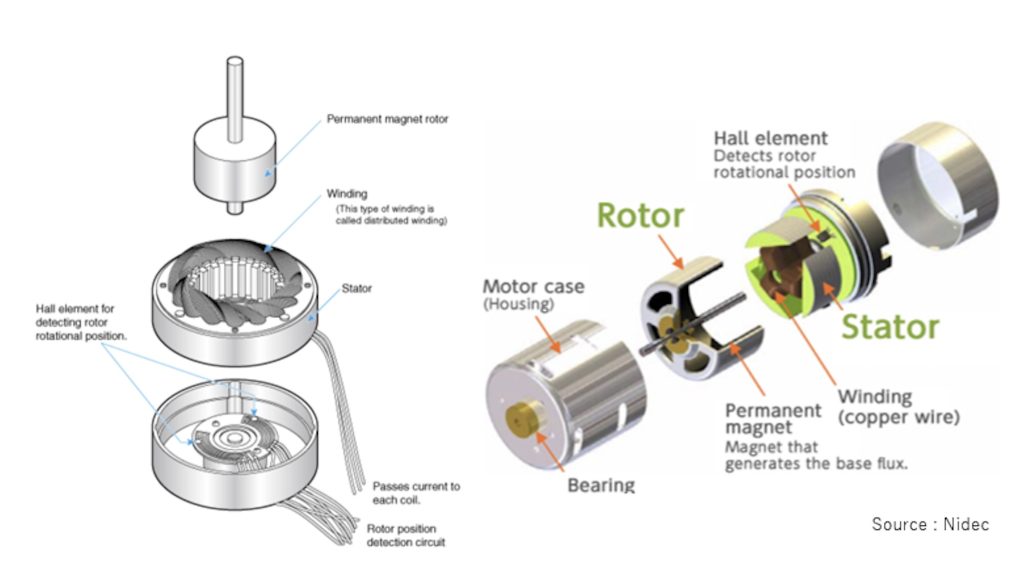
In contrast, Permanent Magnet Synchronous Motors (PMSMs) make use of permanent magnets, often crafted from rare-earth elements like neodymium-iron-boron (NdFeB), embedded within or mounted on their rotor. These magnets establish a strong, constant magnetic field, negating the need for induced currents. As the stator’s three-phase AC current generates a rotating magnetic field, the rotor’s permanent magnets align with it, causing synchronous rotation at the same speed. This unique operation ensures remarkable accuracy and efficiency across varying operational points, eliminating slip.
PMSMs dominate the EV market, accounting for over 75% of vehicle sales since 2015 due to their high efficiency, compact design, and precise speed control. Prominent vehicles utilizing this technology include the BMW i3, VW ID.3/ID.4, Nissan Leaf (newer models), and the Porsche Taycan (for both front and rear axles). Moreover, Tesla’s Model 3 and Model Y primarily feature permanent magnet motors, while newer iterations of the Model S and X have adopted both PMSMs and AC induction motors for optimized performance.
What are the Specific Differences Between AC Induction and Permanent Magnet Motors?
The differences between AC Induction Motors and Permanent Magnet Synchronous Motors are integral to EV performance. PMSMs typically deliver superior efficiency, particularly at partial loads and low speeds, with some models achieving efficiencies as high as 97.5%. In contrast, AC induction motors usually reach peak efficiencies of 90-93%, attributed to rotor copper losses and the necessity for slip. This efficiency advantage translates into enhanced driving range for EVs, a crucial aspect discussed extensively in Understanding EV Battery Health: Factors That Affect Longevity in 2026.
PMSMs also excel in power and torque density, producing more torque per unit mass, facilitating lighter and more compact designs. For instance, a 50 kW permanent magnet motor can weigh less than 30 lbs, while a 75 hp induction motor could surpass 500 pounds. This weight reduction is vital for improving vehicle performance and efficiency, influencing various factors like tire wear, as elaborated upon in Why Do EV Tires Wear Out Faster? Electric vs. Gas Car Comparison.
However, the higher manufacturing costs of PMSMs arise from their reliance on rare-earth magnets, such as neodymium and dysprosium, raising supply chain and sustainability concerns. In contrast, AC induction motors are more cost-effective, as they do not depend on these scarce materials.
Do EV Motor Types Impact Maintenance and Longevity?
Both motor types exhibit robust designs but possess distinct longevity considerations. Induction motors are celebrated for their durability and simplicity, lacking permanent magnets that could demagnetize under high temperature or extreme overload conditions. They exhibit resilience in harsh operating environments. Conversely, the permanent magnets in PMSMs risk demagnetization if subjected to temperatures exceeding approximately 180°C or extreme overload, potentially affecting long-term functionality.
Moreover, PMSMs require complex control systems to ensure precise synchronization and magnetic field management, which is critical for optimizing their operational efficiency. While induction motors need inverters for variable speed control, some industrial applications allow them to function without one. Notably, both motor types in modern EVs are brushless, avoiding the wear issues often associated with traditional DC motors, akin to mechanisms discussed in Transmission Solenoid Failure: How to Identify Symptoms and Save Your Gearbox.
| Feature | AC Induction Motor (ACIM) | Permanent Magnet Synchronous Motor (PMSM) | Electrically Excited Synchronous Motor (EESM) |
|---|---|---|---|
| Rotor Construction | “Squirrel cage” with conductive bars (e.g., copper, aluminum) | Permanent magnets (e.g., NdFeB) | Electromagnets via excitation windings and additional power supply |
| Rare Earth Elements | None required | Required (e.g., Neodymium, Dysprosium) | None required |
| Peak Efficiency | ~90-93% | >95%, up to 97.5% | Comparable to PMSM at specific operating points, but generally lower due to excitation losses |
| Power/Torque Density | Lower; generally larger and heavier for equivalent output | Higher; enables compact and lightweight designs | High; can rival PMSMs in select designs |
| Cost | Generally lower due to simple construction and less expensive materials | Higher due to the cost of rare-earth magnets | Variable; can be lower than PMSM without rare-earth components but adds complexity |
| Thermal Management | Generates heat in rotor due to induced currents | Lower heat generation; sensitive to demagnetization above high temps (>180°C) | Requires cooling for excitation windings; faces similar thermal challenges as ACIM without magnets in rotor. |
| Example Applications | Audi e-tron (front axle in quattro models), GM Ultium (62kW assist motor), Older Tesla Model S/X | Porsche Taycan, BMW i4, Tesla Model 3/Y, most modern EVs | Some niche applications and future designs intending to reduce reliance on rare-earth materials |
Why do Modern EVs Predominantly Utilize Permanent Magnet Synchronous Motors?
Modern electric vehicles predominantly embrace Permanent Magnet Synchronous Motors (PMSMs) for their exceptional efficiency, high torque density, and precise control capabilities—qualities that are essential for maximizing both range and performance. The absence of current losses in the rotor allows PMSMs to produce less heat and waste less energy, directly enhancing driving range—an aspect of utmost importance for both manufacturers and consumers.
PMSMs deliver significant starting torque and maintain consistent power across a wide speed range, facilitating instant acceleration and smooth transitions, making them ideal for diverse driving scenarios, from city streets to highways. Despite their higher initial costs due to rare-earth materials, the long-term energy efficiencies often justify this investment, particularly as operational costs decrease over time.
FAQ: Electric Car Motor Types
What is the primary distinguishing factor between an AC Induction Motor and a Permanent Magnet Synchronous Motor?
The primary distinguishing factor is how each motor generates a magnetic field: AC Induction Motors induce a magnetic field in the rotor through electromagnetic induction, whereas Permanent Magnet Synchronous Motors utilize permanent magnets on the rotor to create a constant magnetic field.
Do all electric cars use rare-earth magnets in their motors?
No, not all electric cars employ rare-earth magnets. While Permanent Magnet Synchronous Motors (PMSMs) constitute over 75% of the EV motor market and rely on rare-earth elements like neodymium, AC Induction Motors do not utilize them.
Can an EV have both AC Induction and Permanent Magnet motors?
Yes, several electric vehicles incorporate a hybrid motor setup. For instance, Tesla’s Model S and X (post-2019 “Raven” models) and Plaid variants utilize both AC induction and permanent magnet synchronous motors to optimize performance across varying speed ranges.
Which motor type is more efficient for electric vehicles?
Permanent Magnet Synchronous Motors (PMSMs) are generally more efficient than AC Induction Motors, often achieving efficiencies exceeding 95%, compared to the 90-93% range typical of induction motors, especially under varying load conditions.
Are Permanent Magnet motors more expensive than Induction motors?
Yes, Permanent Magnet Synchronous Motors typically incur higher manufacturing costs compared to AC Induction Motors, primarily due to the expensive rare-earth permanent magnets used in their rotor designs.