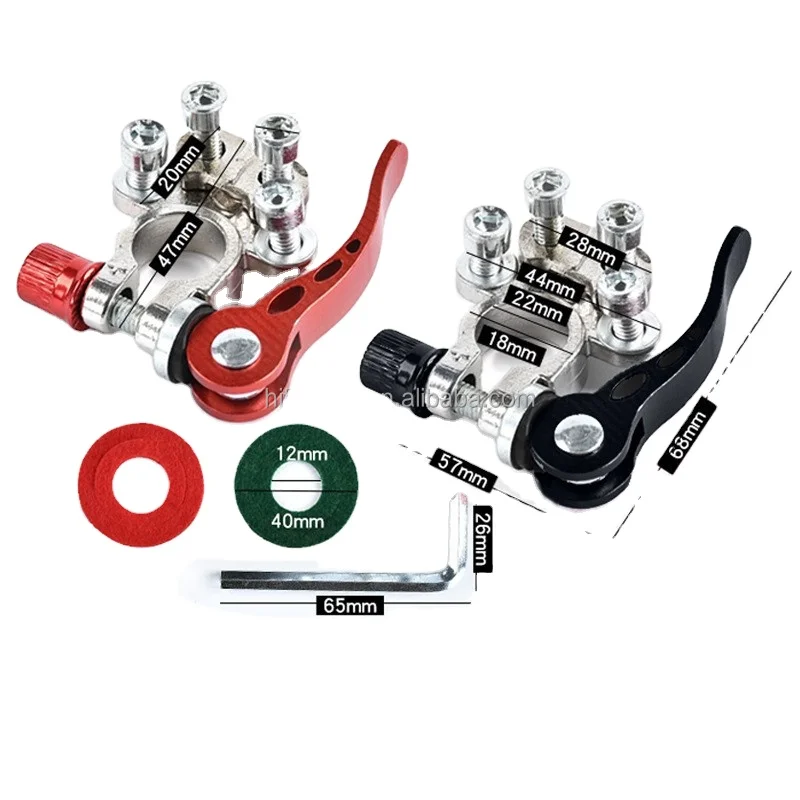
Automotive battery terminals serve as the crucial connection between a vehicle’s electrical system and its 12V lead-acid battery. There are three primary terminal configurations: Top Post, Side Post, and L-Terminals. Each design is tailored to meet specific vehicle requirements and installation geometries, ensuring optimal performance and reliability.
Understanding the types of car battery terminals is essential for vehicle owners as it ensures compatibility when replacing battery components. The three configurations facilitate efficient power delivery for engine starting and accessory operation, maintaining smooth vehicle functionality.
What are the primary types of car battery terminals?
The standard 12V lead-acid car battery employs three distinct terminal designs: Top Post, Side Post, and L-Terminals. These configurations determine the method of connection, physical orientation, and compatibility with a vehicle’s wiring harness, crucial for reliable power delivery.
What are the characteristics of Top Post battery terminals?
Top Post terminals feature two vertically extending lead alloy posts—one positive and one negative. The positive post usually has a larger diameter, approximately 17.5mm, compared to the negative post at around 16mm. This design prevents incorrect polarity connections, enhancing safety during installation.
Connection to Top Post terminals involves cable clamps that fit over the tapered posts and secure with a bolt. This robust design ensures a solid electrical connection and is prevalent in many domestic and imported vehicles, especially older models and heavy-duty applications that require high cranking amperage.
What defines Side Post battery terminals?
Side Post battery terminals are uniquely located on the battery’s side, flush with the casing. Instead of external posts, these terminals feature threaded holes, typically measuring 3/8-inch with 16 threads per inch, to accommodate a specialized terminal bolt for electrical connectivity.
This design offers a compact installation footprint, providing a cleaner aesthetic and reducing the risk of accidental shorting. Side Post terminals are predominantly found in vehicles manufactured by General Motors (GM) since the 1970s.
What are L-Terminals and how do they differ?
L-Terminals, often referred to as JIS (Japanese Industrial Standard) terminals, have a vertical bolt extending from the battery’s top, forming an ‘L’ shape when the cable clamp is attached. A lug with a hole slides over this bolt and secures with a nut, creating a reliable connection.
This type offers flexibility for connecting multiple accessory leads and is mainly found in specific Japanese automotive batteries, commonly used in models from manufacturers like Honda, Toyota, and Mazda.
How do battery terminal types relate to car battery replacement costs?
While the terminal type doesn’t inherently alter the base cost of the battery, it plays a crucial role in ensuring compatibility and can marginally impact labor complexity during installation. For example, specialized tools may be necessary for side post connections, potentially affecting installation time.
In 2026, the average cost of a professional car battery replacement, which includes both the battery and installation, ranges from $268 to $368 for standard 12V vehicles. For a basic lead-acid battery replacement, expect costs between $120 and $300, depending on the terminal configuration and specific vehicle needs. Understanding your vehicle’s terminal type is vital for selecting the right replacement battery to ensure proper fitment.
How does battery terminal integrity impact overall vehicle performance?
Corroded or loose battery terminals can severely hinder the efficient flow of electrical current, leading to symptoms that may mimic failing vehicle components. For instance, compromised battery terminals might result in abrupt or delayed gear shifts or noticeable shudders during acceleration, which can be mistaken for transmission solenoid failures.
Moreover, poor electrical connections at the terminals can illuminate the Check Engine Light (CEL) and generate diagnostic trouble codes (DTCs). Neglecting to check the integrity of battery terminals during troubleshooting could lead to misdiagnosis and unnecessary repairs, as emphasized in our article on transmission solenoid failure.
Do EV battery packs utilize similar terminal designs?
Electric vehicle (EV) battery packs, comprising high-voltage, high-capacity lithium-ion systems, fundamentally differ from 12V lead-acid batteries. EV battery packs do not utilize the conventional Top Post, Side Post, or L-Terminal designs.
Instead, they incorporate specialized high-current connectors and busbar systems designed for significant power flow management and safety, often contained within sealed, temperature-controlled enclosures. As of 2026, the average annual degradation rate for EV batteries is at 2.3%, potentially increasing to 3.0% in vehicles subjected to frequent DC fast charging. This advanced power architecture necessitates a highly engineered connection method, distinct from traditional 12V battery terminals, as detailed in our guide on EV battery health.
Comparative Analysis of Car Battery Terminal Types
| Feature | Top Post Terminals | Side Post Terminals | L-Terminals (JIS) |
|---|---|---|---|
| Physical Location | Vertical posts on battery top surface | Threaded holes on battery side surface | Vertical bolt on battery top surface |
| Connection Method | Tapered posts with cable clamps | Threaded holes with terminal bolts | Vertical bolt with lug and nut |
| Common Diameter/Thread | Positive ±17.5mm, Negative ±16mm | 3/8-inch, 16 threads per inch | Varies, typically M6 or M8 bolt |
| Primary Application | Many domestic/import vehicles, heavy-duty | General Motors (GM) vehicles (post-1970s) | Specific Japanese vehicle models (Honda, Toyota, Mazda) |
| Key Advantage | Robust connection, easy accessibility | Compact, reduced accidental shorting risk | Secure connection, accessory flexibility |
Frequently Asked Questions (FAQ)
Can I convert my car battery from Top Post to Side Post?
Direct conversion of a battery’s terminal type is not feasible, as batteries are specifically designed for one configuration. While adapters exist, they can introduce resistance and are generally not recommended for primary connections.
What is the best way to clean corroded battery terminals?
The optimal method for cleaning corroded terminals involves disconnecting the battery, using a wire brush, and a solution of baking soda and water (approximately 1 tablespoon of baking soda per cup of water) to neutralize and scrub away corrosion. Finish by rinsing with clean water and thoroughly drying the area.
Do all 12V car batteries have the same terminal configuration?
No, 12V car batteries do not all share the same terminal configuration; they typically utilize Top Post, Side Post, or L-Terminals, depending on the vehicle manufacturer and specific application needs.