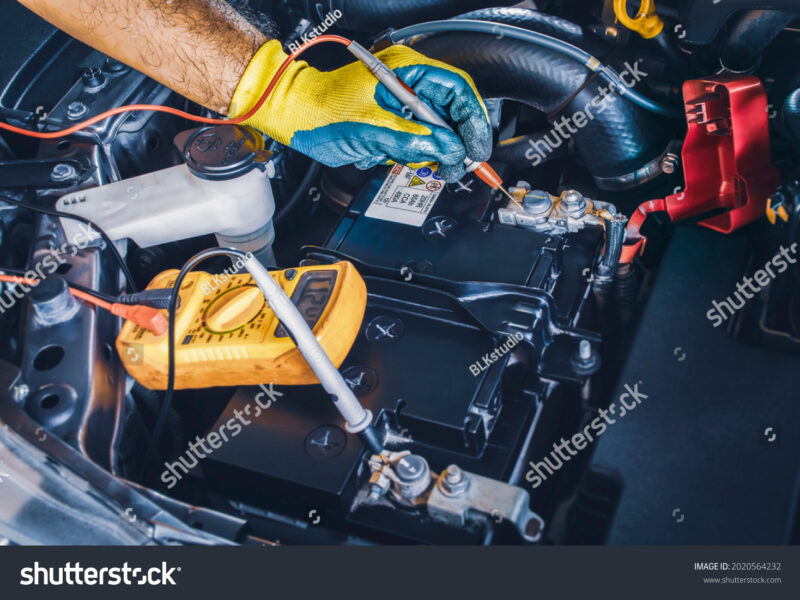
The clearest signs of a failing car battery are slow cranking, dim or flickering lights, repeated jump starts, corrosion on the terminals and sometimes a battery symbol on the dashboard. Haynes says several of these can also come from the charging system or poor connections, so test before replacing anything.
What are the signs of a dying car battery?
- Slow cranking. Haynes calls a sluggish crank one of the earliest signs: the engine takes a beat longer to catch or sounds weaker than it did weeks ago. Cold mornings make it worse because low temperatures reduce a battery’s ability to produce power.
- Dim or flickering lights. Headlights that look weaker than usual, a flickering dashboard at idle, or interior lights that dim when a door opens. Haynes notes that an aging alternator or a poor connection can cause similar behaviour, so test the charging system before buying a battery.
- Frequent jump starts. One jump after leaving the lights on is normal, says Haynes; needing help every week or two is not, and suggests the battery is no longer holding a charge between drives.
- Corrosion on the terminals. White, blue, yellow or greenish deposits. Haynes says loose or heavily corroded terminals can mimic a weak battery: the battery may hold charge but poor contact stops it reaching the starter. See how to clean battery terminals.
- A battery warning light. The Haynes UK guide says a battery symbol means a fault in the charging system, not necessarily a bad battery. The car is then running on the battery alone, which will run out quickly. Causes range from a loose terminal or bad earth to a snapped belt or failing alternator.
Haynes’ UK guide adds that some modern batteries have a charge indicator window: green means at least 75% charge, black means it needs charging and red means it is dead. Not every battery has one.
| Sign | Could also be | Test first |
|---|---|---|
| Slow cranking | Cold weather, poor connection | Resting voltage after a rest |
| Dim or flickering lights | Aging alternator, poor connection | Voltage with the engine running |
| Frequent jump starts | Charging fault, something draining the battery | Full charge, then see if it holds |
| Corroded terminals | Poor contact with a healthy battery | Clean and tighten the terminals |
| Battery symbol on the dash | Charging system fault (Haynes UK) | Alternator, belt and terminals |
How do you test a car battery?
- Let the battery rest. If the car has been driven, wait at least an hour, or test first thing in the morning (Haynes, battery check guide).
- Inspect the terminals and cables. Look for corrosion, check the cables are tight by wiggling them, and check that the hold-downs are tight, the cables are not heat-damaged or pinched and the battery case is not swollen or cracked.
- Measure the voltage with a multimeter across the terminals. Haynes says it should read about 12.6 volts at rest. Its UK guide gives 12.7 V as excellent, 12.4 V as okay and anything under 12 V as a battery running out of life.
- Test with the engine running. Haynes says a healthy charging system reads between 13.8 and 14.4 volts at idle.
Voltage alone cannot show a battery that reads fine but fails under load, so a load test at a parts store or garage is the more reliable check.
For the voltage ranges and what each reading means, see how to test a car battery with a multimeter.
See also what a battery voltage drop means.
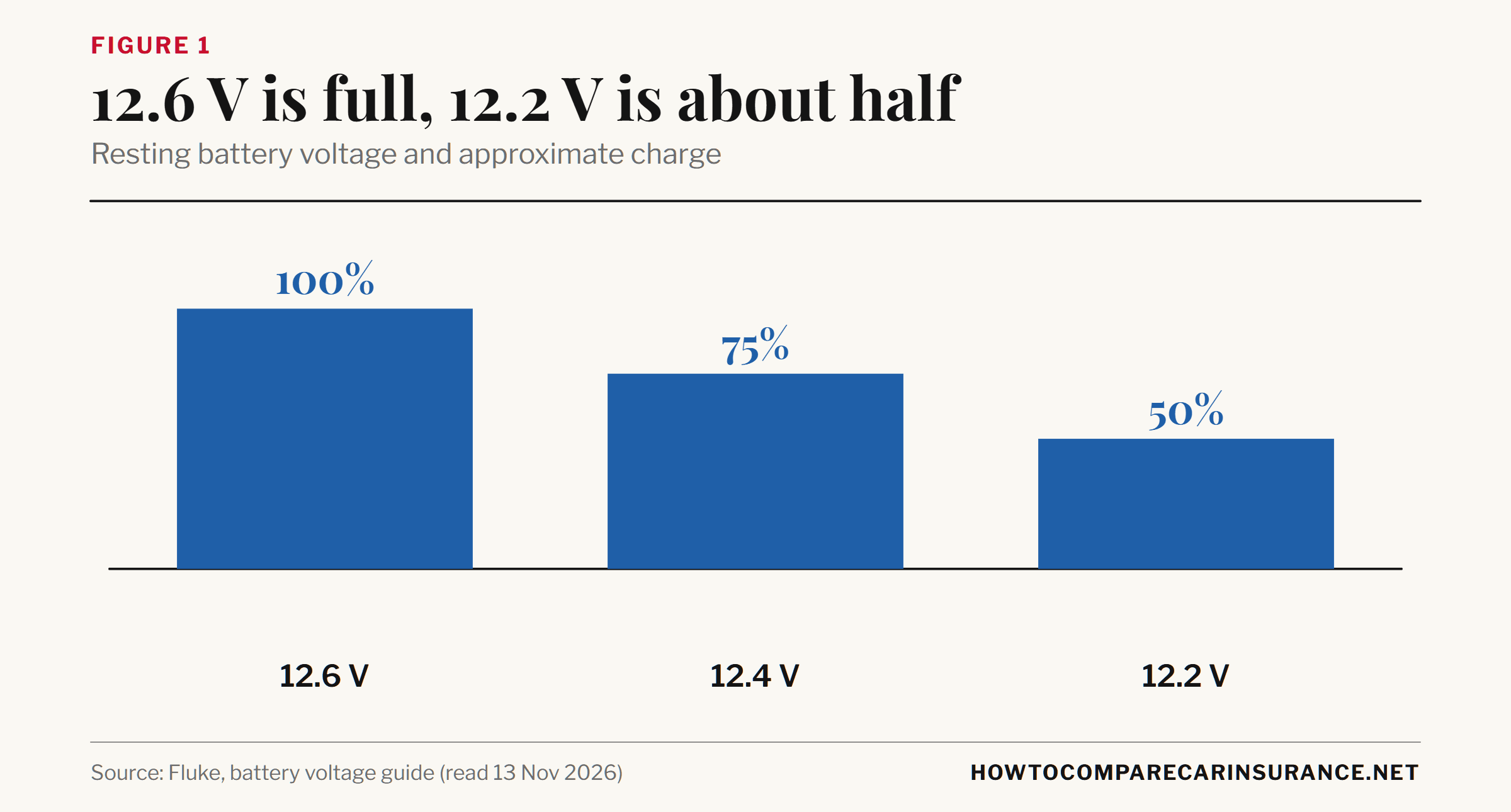
The sources we read differ slightly on the exact numbers:
| Source | Engine off, rested | Engine running |
|---|---|---|
| Fluke (multimeter maker) | 12.6 V full; 12.4 V about 75%; 12.2 V about 50%; under 12.0 V weak | 13.7 to 14.7 V |
| Haynes (U.S.) | About 12.6 V or higher; below 12.2 V charge or replace | 13.8 to 14.4 V at idle |
| Haynes (UK) | 12.7 V excellent; 12.4 V okay; under 12 V running out of life | Not stated |
| Rick’s Free Auto Repair Advice | 12.6 V and 12.4 V points; 12.2 V minimum to test from | 13.0 to 15.0 V on smart-charging cars; over 13 V steady at about 2,000 rpm |
Why do car batteries fail?
Haynes lists several causes: heat can boil the acid away (often caused by an over-charging alternator) or evaporate it over time; extreme cold can freeze it and crack the case.
Rough roads and engine vibration can break the lead plates or their connections; and sulfation, a build-up of lead sulfate crystals, reduces the power the battery can store over a few years. Haynes advises inspecting and testing the battery every six months.
For how long batteries last see how long car batteries last.
Frequently asked questions
How do I know if it is the battery or the alternator?
Per Haynes, a battery that will not hold about 12.6 volts after a full charge is the problem, while a low reading with the engine running points to the charging system.
A symbol on the dashboard points to the charging system. See the alternator and your battery.
What voltage means a car battery is dying?
On Fluke’s scale a rested battery under 12.0 V is likely discharged or weak, and about 12.2 V is roughly half charged.
Haynes says below 12.2 V it needs charging or replacing. A voltage reading alone cannot show a battery that fails under load.
How often should I test my battery?
Haynes says every six months, for example when rotating or swapping tires, so that a marginal battery is caught before extreme heat or cold.
Can a car battery die without warning?
Haynes says a failing battery rarely fails without warning signs, though they can be subtle and appear gradually.
Sources: Haynes, “Battery check” (U.S., August 2025); Haynes, “How long do car batteries last?” (UK, January 2024); Haynes, “5 Common Dead Battery Symptoms In A 2017-2022 Honda CR-V” (U.S., August 2026; written for one model, but the symptoms are general).