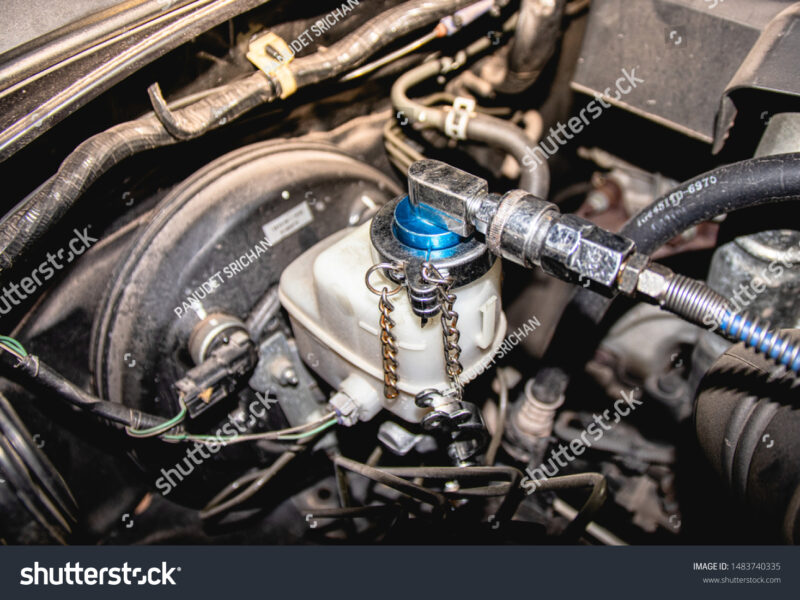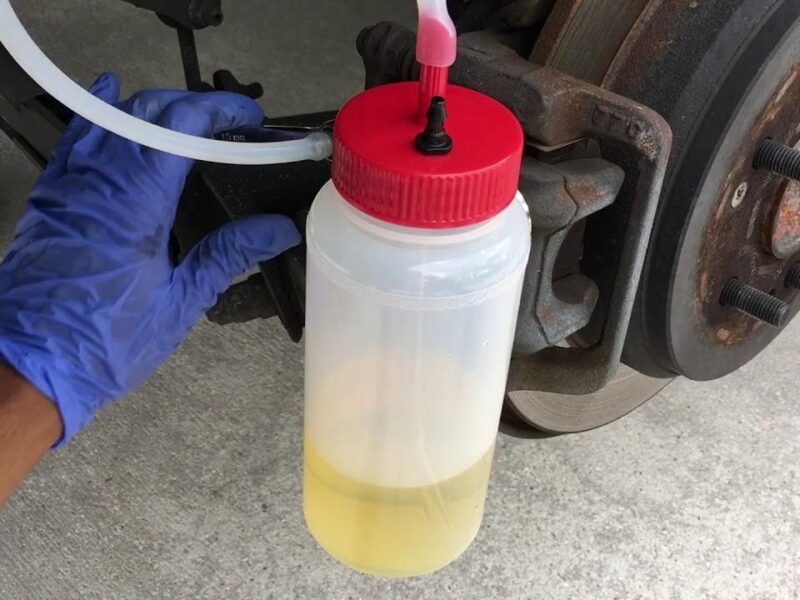
Change brake fluid at the interval in your owner’s manual. As a rule of thumb, Haynes recommends every two years or 30,000 miles, and every year if you tow or drive hard. Time matters more than mileage, because the fluid absorbs moisture from the air.
How often should you change brake fluid?
The interval for changing brake fluid is set by your carmaker, so the owner’s manual is the first place to look. The sources we read give these figures:
| Source | What it says | Date |
|---|---|---|
| Your owner’s manual | The interval and fluid grade for your car; takes priority | Varies |
| Haynes (U.S.) | Every 2 years or 30,000 miles; every year if you tow or drive aggressively | March 2020 |
| Haynes (UK) | Most manufacturers recommend every 2 years regardless of mileage | November 2019 |
| Carmakers (per Haynes) | Vary: some say every 3 years, some give no interval at all | 2020 |
| 49 CFR 571.116 (FMVSS 116) | Sets boiling-point minimums; does not set a service interval | Text read 13 Nov 2026 |
- Follow your owner’s manual first. It gives the interval and the fluid grade for your car.
- Haynes’ rule of thumb is every two years or 30,000 miles, and once a year if you tow a trailer or drive aggressively. It says a “lifetime” fluid in a car with no factory interval is still worth changing.
- Time matters more than mileage. The moisture is absorbed whether or not the car is driven, which is why the Haynes UK guide says to change it every two years regardless of mileage.
Haynes’ articles date from 2019 (UK guide) and 2020 (U.S. guide) and are advice from a manual publisher, not a regulation.
Why does brake fluid need to be changed?
Most brake fluid is hygroscopic: it absorbs moisture from the air. Haynes says the more moisture it absorbs, the lower its boiling point and the more prone it is to overheating and fading, and that moisture also corrodes calipers, wheel cylinders and brake lines from the inside.
If the fluid boils, bubbles form, the fluid can be compressed, and the pedal goes soft. That can happen after long, hard braking such as a steep descent.
The U.S. standard for brake fluid, 49 CFR 571.116 (FMVSS No. 116), builds this into its test. It sets a minimum boiling point for fresh fluid (dry) and a lower minimum after the fluid has taken up water (wet):
| Grade | Minimum dry boiling point | Minimum wet boiling point | Difference (our calculation) |
|---|---|---|---|
| DOT 3 | 205 °C (401 °F) | 140 °C (284 °F) | 65 °C |
| DOT 4 | 230 °C (446 °F) | 155 °C (311 °F) | 75 °C |
| DOT 5 (including DOT 5.1) | 260 °C (500 °F) | 180 °C (356 °F) | 80 °C |
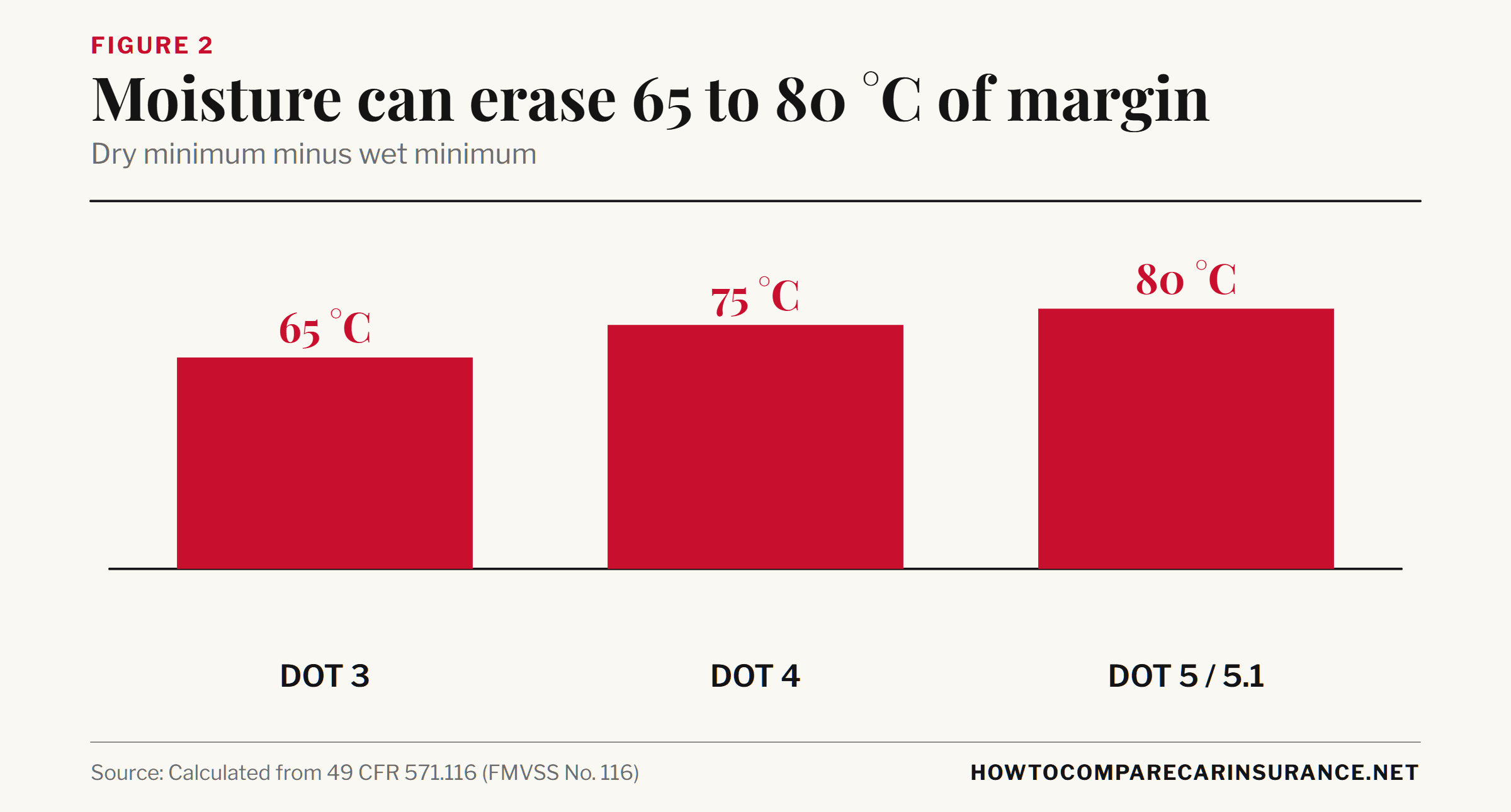
The gap between the dry and wet columns is the margin that moisture can eat. The standard also requires containers to warn you to keep brake fluid clean and dry and the container tightly closed to prevent absorption of moisture.
The standard does not set a service interval and it does not say how much water the fluid in your car has absorbed, so the difference column describes the test minimums, not your car.
Not every fluid behaves this way. DOT 5 silicone fluid does not absorb water in the same way, but the grades are not interchangeable; see DOT 3, DOT 4, DOT 5 and DOT 5.1 brake fluid.
How can you tell the fluid is due for a change?
| Check | What Haynes says | Reliable on its own? |
|---|---|---|
| Colour and clarity | Fluid should be clear; darkness, murkiness or a burned smell means it should go | No: moisture is not visible |
| Pedal feel | A pedal spongier than it used to be is a sign | No: other faults cause it too |
| Reservoir level | Level falls as brake pads wear | No: a low level is not automatically a leak |
| Age of the fluid | Two years or 30,000 miles as a rule of thumb | Best simple guide, after the manual |
For the full list of symptoms see signs you need a brake fluid change.
For how to read the reservoir see how to check your brake fluid level and colour.
If you decide to do the job yourself, read how to change brake fluid first.
Frequently asked questions
Does brake fluid need changing if the car barely moves?
Yes. The Haynes UK guide recommends the change regardless of mileage, because the moisture is absorbed from the air over time.
Can I top up old brake fluid instead of changing it?
Topping up replaces only what is missing and does not remove the moisture already in the system. Haynes says to use only new fluid from a sealed container, because an open container absorbs moisture from the air.
What brake fluid does my car need?
Use the grade marked on the master cylinder cap and in the owner’s manual.
How much does water lower the boiling point of brake fluid?
In FMVSS No. 116 the wet minimum is 65 °C lower than the dry minimum for DOT 3, 75 °C for DOT 4 and 80 °C for DOT 5. Those are test minimums, not a measurement of your fluid.
Is a low brake fluid level a sign of a leak?
Not necessarily. Haynes says the level falls as the pads wear, so a lower level is not automatically a leak.
Sources: 49 CFR 571.116 (eCFR, current text read 13 November 2026); Haynes, “How To Change Your Brake Fluid” (U.S., March 2020) and “Brake fluid change: how much and how often?” (UK, November 2019). Difference column and chart calculated from the standard’s minimums.