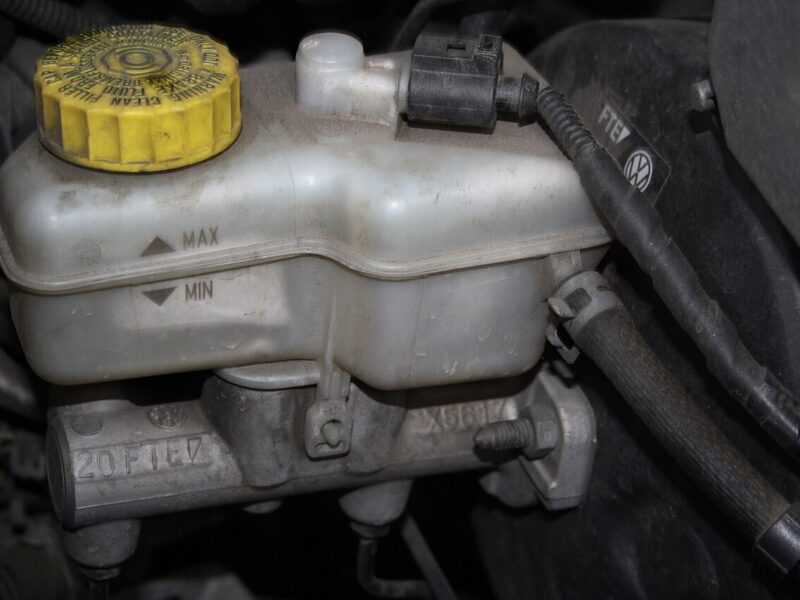
DOT 3, DOT 4, DOT 5 and DOT 5.1 are brake fluid grades defined by the U.S. standard FMVSS No. 116. The minimum boiling point rises from DOT 3 to DOT 5, and DOT 5 is silicone based and should not be mixed with the others. Use the grade marked on your master cylinder cap and in your owner’s manual.
What do DOT 3, DOT 4, DOT 5 and DOT 5.1 mean?
The DOT numbers are grades in the U.S. brake fluid standard, 49 CFR 571.116 (FMVSS No. 116). The standard sets a minimum boiling point for each grade:
| Grade | Minimum dry boiling point | Minimum wet boiling point | Maximum viscosity at −40 °C |
|---|---|---|---|
| DOT 3 | 205 °C (401 °F) | 140 °C (284 °F) | 1,500 mm²/s |
| DOT 4 | 230 °C (446 °F) | 155 °C (311 °F) | 1,800 mm²/s |
| DOT 5 and DOT 5.1 | 260 °C (500 °F) | 180 °C (356 °F) | 900 mm²/s |
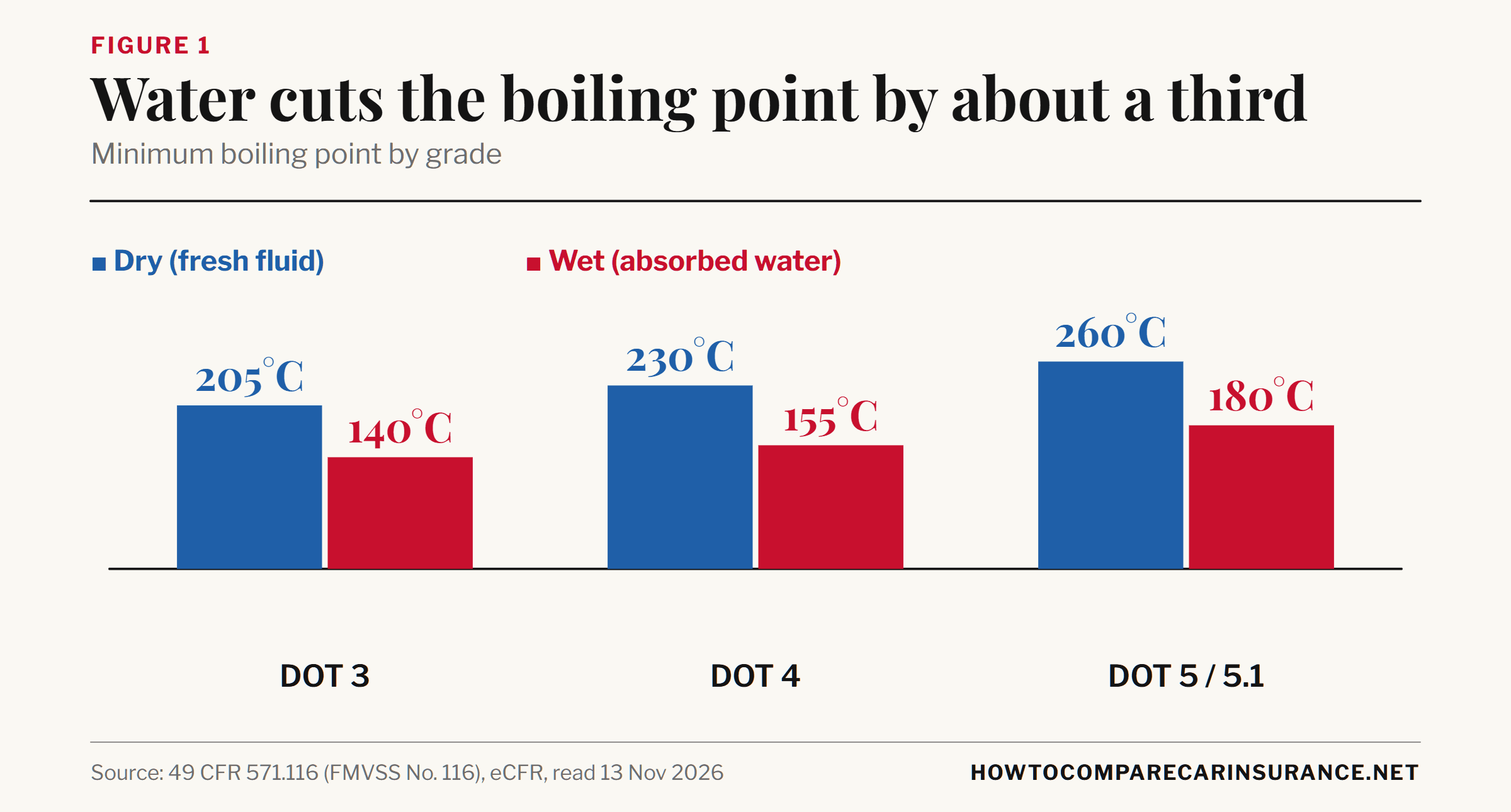
In the standard, DOT 5 is one grade that must be labelled either “DOT 5 SILICONE BASE” or “DOT 5.1 NON-SILICONE BASE”. The standard defines a silicone-base fluid as one that is at least 70% diorgano polysiloxane by weight. These are minimums set by the standard, so individual products can exceed them.
How much does water lower the boiling point?
The wet minimum is the number that matters in an older car, because brake fluid takes up moisture over time. Subtracting the wet minimum from the dry minimum gives the margin the standard allows moisture to remove:
| Grade | Dry minimum | Wet minimum | Difference | Difference as % of dry minimum |
|---|---|---|---|---|
| DOT 3 | 205 °C | 140 °C | 65 °C | 31.7% |
| DOT 4 | 230 °C | 155 °C | 75 °C | 32.6% |
| DOT 5 and DOT 5.1 | 260 °C | 180 °C | 80 °C | 30.8% |
The last two columns are our own arithmetic on the standard’s minimums; the standard does not state them. They are not measurements of any product or of the fluid in your car. They show that, across the three rows, the allowed drop is roughly a third of the dry minimum.
For how fast fluid ages and when to replace it, see how often to change brake fluid.
How do the fluid types differ?
| Grade | Base | Colour in the standard | Absorbs water? | Source |
|---|---|---|---|---|
| DOT 3 | Glycol ether | Colourless to amber | Yes (hygroscopic) | FMVSS 116; Wikipedia |
| DOT 4 | Glycol ether | Colourless to amber | Yes (hygroscopic) | FMVSS 116; Wikipedia |
| DOT 5.1 | Glycol ether, non-silicone | Colourless to amber | Yes (hygroscopic) | FMVSS 116; Wikipedia |
| DOT 5 | Silicone | Purple | Not in the same way | FMVSS 116; Wikipedia |
- DOT 3, DOT 4 and DOT 5.1 are glycol-ether based and hygroscopic, meaning they absorb moisture from the air, according to Wikipedia’s summary of brake fluid. That is why they need regular replacement.
- DOT 5 is silicone based. The same source says it does not absorb water like the glycol fluids, is more compressible (which can give a spongier pedal) and should not be mixed with the others. It also says DOT 5 can aerate when an anti-lock brake system is working and is not compatible with ABS. If your car has ABS, check the manual before considering it.
- Colour does not tell you the grade of old fluid. Old fluid in a car can be any colour.
Wikipedia is a general reference, not a technical specification, so treat the compatibility points as pointers to check against your manual rather than as instructions.
Which brake fluid should you use?
- Use the grade your car specifies. Haynes says to use the fluid specification marked on the master cylinder cap and in the car’s manual.
- Do not go below the specified grade. Going by the tables above, a lower grade has a lower minimum boiling point, so it leaves less margin than the carmaker planned for. This is our reading of the table, not a statement from the standard.
- Do not mix silicone DOT 5 with glycol fluids. Wikipedia says they should not be mixed.
- Buy sealed, new fluid. Haynes says fluid from an open container will already have absorbed moisture.
- Read the label. The standard requires the container to show the grade and the minimum wet boiling point in °F.
Related: how to change brake fluid and how to check your brake fluid level and colour.
Frequently asked questions
Can I use DOT 4 in a car that asks for DOT 3?
The standard does not say which grade is compatible with which car. Check the manual for your car; Wikipedia says the glycol-based grades (DOT 3, 4 and 5.1) can be mixed, but that replacing the fluid completely is preferable.
Is DOT 5.1 the same as DOT 5?
No. In the standard both fall in the DOT 5 grade, but DOT 5.1 is the non-silicone version and DOT 5 is silicone based, and they should not be mixed.
Does a higher DOT number always mean better brakes?
It means a higher minimum boiling point in the standard’s tests. It does not mean the fluid suits every car, so follow the grade specified for yours.
What is the boiling point of DOT 4 brake fluid?
FMVSS No. 116 requires at least 230 °C (446 °F) dry and 155 °C (311 °F) wet. Individual products can exceed these minimums.
What colour is each brake fluid?
The standard says DOT 3, DOT 4 and DOT 5.1 must be colourless to amber and DOT 5 silicone must be purple.
Sources: 49 CFR 571.116 (eCFR, current text read 13 November 2026); Wikipedia, “Brake fluid” (read 13 November 2026); Haynes, “How To Change Your Brake Fluid” (U.S., March 2020). Difference columns calculated from the standard’s minimums.