Optimizing the brake pedal ratio is fundamental for enhancing a vehicle’s braking efficiency, ensuring a responsive pedal feel, and boosting driver confidence in both performance and custom applications. This mechanical advantage hinges on specific leverage points within the pedal assembly, defining how the force exerted by the driver’s foot converts into hydraulic pressure within the master cylinder. The effectiveness of this conversion plays a crucial role in braking performance and stopping distances.
What Defines the Brake Pedal Ratio?
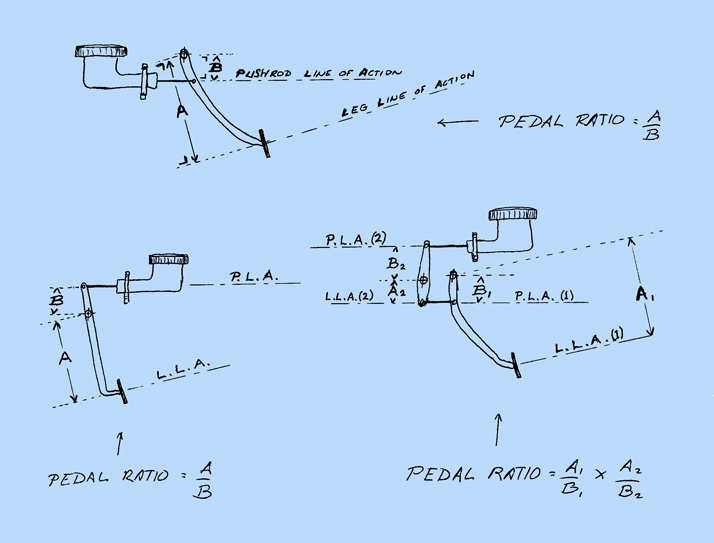
The brake pedal ratio represents the mechanical leverage applied by the brake pedal to the master cylinder pushrod. It is characterized by the geometric relationship among three pivotal points: the pedal’s pivot point, the center of the pedal pad where force is applied, and the pivot point of the master cylinder pushrod.
How Is Brake Pedal Ratio Precisely Calculated?
To calculate the brake pedal ratio, divide the distance from the pedal’s pivot point to the center of the pedal pad (Measurement A) by the distance from the pivot to the center of the master cylinder pushrod (Measurement B).
For illustration, if Measurement A equals 12 inches and Measurement B is 3 inches, the resulting pedal ratio would be 4:1 (12 ÷ 3 = 4). This ratio signifies the mechanical multiplication of the driver’s foot force, directly affecting performance.
How Does Pedal Ratio Impact Braking Force and Pedal Feel?
A higher brake pedal ratio yields a greater mechanical advantage, enabling the driver to create higher hydraulic line pressure with less foot effort. In contrast, a lower ratio necessitates increased force to achieve the same line pressure.
Yet, an elevated pedal ratio often leads to greater pedal travel during the master cylinder’s stroke. This intricate relationship between force, travel, and hydraulic pressure is essential to attaining the ideal pedal feel, ranging from soft and lengthy to firm and short.
What Are Typical Pedal Ratios for Different Brake Systems?
- For manual (non-boosted) brake systems, standard pedal ratios typically range from 5:1 to 7:1, with an optimal target often set around 6:1 or 7:1 for optimal pedal feel.
- In power-assisted brake systems, the typical ratio is between 2.5:1 and 4:1, with 4:1 being common in modern OEM vehicles.
These variations account for the presence or absence of a brake booster, which significantly amplifies the driver’s input force into the hydraulic system.
What Are the Methods for Optimizing Brake Pedal Ratio?
Optimizing the brake pedal ratio primarily entails adjusting the distances ‘A’ or ‘B’ relative to the pedal’s pivot point. For custom builds and performance setups, this may require redesigning the pedal assembly or relocating the master cylinder pushrod attachment point on the pedal arm.
Adjustable pedal assemblies, commonly found in aftermarket performance kits, provide multiple pushrod attachment holes, allowing for precise ratio tuning without extensive modifications. Moving the pushrod connection closer to the pedal pivot enhances the ratio, while positioning it further away reduces it.
How Do Master Cylinder Bore Size and Brake Components Influence Pedal Ratio Effectiveness?
The brake pedal ratio must align with both the master cylinder bore size and the total piston area of the brake calipers to achieve optimal hydraulic pressure and pedal feedback. A smaller master cylinder bore produces higher line pressure for a given pedal force but requires more pedal travel to displace the necessary fluid volume. Conversely, a larger bore creates a firmer pedal with less travel but results in lower line pressure.
An incorrect bore size paired with an unsuitable pedal ratio can lead to issues such as a soft or spongy pedal, excessive pedal travel, or an overly hard pedal that requires considerable force. For example, a 1-inch bore master cylinder combined with a 6:1 pedal ratio and 100 pounds of pedal force generates approximately 600 pounds of force at the master cylinder.
Comparative Analysis of Brake System Configurations:
| Configuration | Pedal Ratio (Typical) | Master Cylinder Bore (Typical) | Pedal Feel | Hydraulic Line Pressure (PSI @ 100lb pedal force) |
|---|---|---|---|---|
| Manual Brakes (Performance) | 6:1 – 7:1 | 7/8″ – 1″ | Firm, Moderate Travel | 600 – 700 PSI (with 1″ bore) |
| Power Brakes (OEM Street) | 4:1 | 1″ – 1-1/8″ | Softer, Shorter Travel | ~400 PSI (with 1″ bore) |
| Manual Brakes (Off-Road/Large Caliper) | 10:1 (e.g., Wilwood specific) | 1″ – 1-1/8″ (to manage volume) | Moderate, Longer Travel | ~1000 PSI (with 1″ bore) |
Ensuring the proper match between these components is essential. If a vehicle exhibits a “spongy” brake pedal or necessitates excessive travel to engage the brakes, it may be indicative of trapped air in the hydraulic system or critically low brake fluid levels, which undermine the system’s incompressibility. For further insight into these symptoms, consult 7 Dangerous Symptoms of Low Brake Fluid You Should Never Ignore.
Additionally, it’s vital to monitor other braking components. A sticking brake caliper may cause the vehicle to pull to one side during braking, signaling a failure to fully release. Understanding such complexities is vital for ensuring overall braking integrity. More insights can be found in Diagnosing a Sticking Brake Caliper: Symptoms, Causes, and Fixes.
Lastly, the choice of brake pads, whether ceramic or semi-metallic, considerably affects overall stopping power, especially during heavy towing or high-performance scenarios. For in-depth information about optimal pad selection, explore Top 5 Best Brake Pads for Heavy Towing and Hauling in 2026.
Frequently Asked Questions (FAQ)
What is the ideal brake pedal ratio for a manual brake conversion?
For a manual brake conversion, the ideal brake pedal ratio typically falls between 6:1 and 7:1, ensuring sufficient hydraulic pressure while maintaining a comfortable pedal effort.
Does brake pedal ratio affect stopping distance?
Yes, even a minor variation in the brake pedal ratio can cause significant shifts in clamping forces, directly influencing stopping distance and overall brake performance.
Can an incorrect brake pedal ratio cause a hard brake pedal?
Indeed, an incorrect brake pedal ratio can substantially contribute to a hard brake pedal, especially if the pushrod travel is inadequate to move the master cylinder piston efficiently.
What master cylinder bore size is recommended for a 6:1 pedal ratio?
For a 6:1 pedal ratio, a 1-inch or 1-1/8-inch bore master cylinder is generally recommended, depending on the caliper piston area and the desired pedal feel.