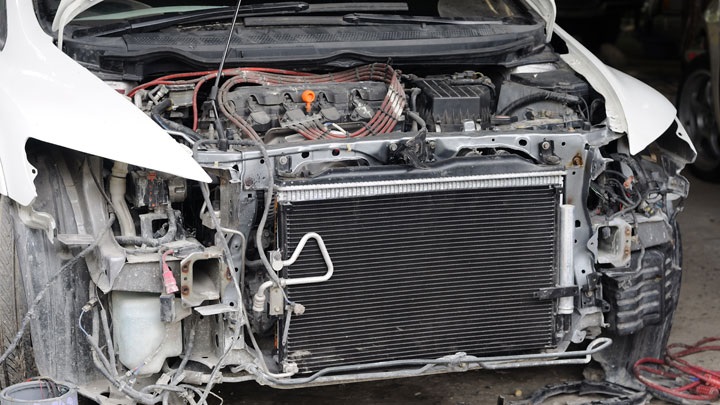
A failing radiator fan motor is more than just an inconvenience; it poses a serious threat to your vehicle’s health. It compromises your vehicle’s ability to dissipate excess heat, especially when idling or moving at low speeds. This malfunction prevents the engine from maintaining its optimal operating temperature, which can lead to catastrophic consequences. Unlike a malfunctioning thermostat that primarily regulates coolant flow or a water pump that circulates coolant throughout the system, the radiator fan is responsible for forcing airflow over the radiator fins. This process is crucial for heat exchange when natural airflow is insufficient. Ignoring a faulty radiator fan motor can cause the engine temperature gauge to soar above 250°F (121°C), risking severe damage such as warped cylinder heads or engine seizure.
What Are the Primary Indicators of a Defective Radiator Fan Motor?
Recognizing the signs of a failing radiator fan motor early can save you from major engine damage. Unlike issues stemming from the water pump or thermostat, which directly involve coolant circulation and temperature regulation, radiator fan issues manifest distinctively.
1. Why Is the Engine Overheating, Especially at Low Speeds or Idling?
A significant sign of a failing radiator fan motor is an alarming rise in engine temperature when the vehicle is stationary or at speeds below 25 mph (40 km/h). In these conditions, the vehicle’s motion does not generate sufficient airflow through the radiator, making cooling ineffective. The radiator fan compensates for this, but if it fails to activate or operates intermittently, the engine temperature gauge can easily exceed its normal range of 195-220°F (90-105°C) and approach the danger zone of 250°F (121°C).
2. Is the Radiator Fan Not Activating or Running Constantly?
In a properly functioning system, the radiator fan engages based on signals from the engine coolant temperature (ECT) sensor, usually at temperatures between 180°F (82°C) and 210°F (99°C). If the fan fails to turn on when needed—or runs non-stop even when the engine is cool—it points to an electrical or mechanical fault within the fan motor or its control circuit. Continuous operation could indicate a stuck relay, a faulty ECT sensor, or an ECU problem, while failure to activate suggests serious issues with the motor or wiring.
3. Are There Unusual Noises Emitting from the Radiator Fan Assembly?
A well-functioning radiator fan motor emits a consistent, low hum. Any deviation, like grinding or squealing noises, typically signifies worn bearings or an imbalanced fan blade. For instance, a high-pitched squeal may indicate dry or failing bearings, while a grinding noise suggests significant internal wear. It’s essential to distinguish these sounds from ticking or grinding coming from the engine front, which often indicates water pump failure.
4. Is There a Visible Slowdown or Irregularity in Fan Blade Rotation?
When operational, the radiator fan blades should spin at a steady rate of 1,100 to 2,700 RPM, depending on cooling demand. If you notice a slowdown in speed or inconsistent operation, it reflects a weakening motor or resistance in the motor’s windings. This inefficiency can lead to coolant temperatures soaring beyond the optimal levels by 10-15°F (5-8°C) during peak loads.
5. Are Fuses Repeatedly Blowing or Is the Fan Motor Emitting a Burning Smell?
Repeatedly blown fuses in the radiator fan circuit—typically rated between 7-15 amps for a single fan—indicate excessive current draw, often stemming from increased resistance or a short circuit within the motor. Alongside this, a burning smell from the fan motor area signals electrical overheating, which could lead to complete motor failure if not addressed. High temperatures can degrade the insulation of the motor windings, presenting a fire hazard.
6. Have Diagnostic Trouble Codes (DTCs) Related to Fan Operation Appeared?
Modern vehicles utilize On-Board Diagnostics II (OBD-II) systems to monitor the radiator fan motor and its control circuits. Specific DTCs, such as P0480 and P0481, can indicate issues with the fan control circuit or the motor itself. These codes provide crucial insight into potential electrical problems, mechanical failures, or wiring issues, facilitating a more efficient diagnostic process when checked with an OBD-II scanner.
What Are the Common Causes of Radiator Fan Motor Failure?
Radiator fan motors endure considerable stress during operation, leading to several common failure causes:
- Electrical Component Degradation: Carbon brushes wear down, and armatures develop faults over time, increasing resistance and possibly causing total failure.
- Bearing Failure: Exposure to moisture and prolonged high temperatures can cause internal bearings to wear out or seize, increasing friction and power draw.
- Relay or Fuse Malfunction: A faulty relay or blown fuse can hamper the fan’s operation, even if the motor is otherwise functional.
- Impact Damage/Debris Accumulation: Physical damage from road debacle or accidents can cause vibration and premature failures.
- Wiring Harness Corrosion/Damage: Corrosion of connectors can lead to high resistance or total loss of power to the fan motor.
How Do You Diagnose a Failing Radiator Fan Motor?
To accurately diagnose a fan motor issue, you must differentiate it from other cooling system problems. Here’s a structured approach:
| Diagnostic Method | Objective | Expected Outcome (Good Motor) | Expected Outcome (Failing Motor) |
|---|---|---|---|
| Visual Inspection | Check for physical damage, wiring integrity, and obstruction of fan blades. | Intact blades, clean wiring with no corrosion. | Cracked blades, debris, frayed wires, and corrosion present. |
| Fuse/Relay Check | Verify electrical supply to the fan circuit. | Continuity in fuses, functional relays, voltage at fan connector around 12V. | Blown fuses; non-functional relays; 0V at fan connector. |
| Direct Power Test | Bypass controls to test motor functionality directly. | Fan activates immediately with appropriate speed. | No activation or excessive noise when activated. |
| Resistance/Continuity Test (Motor) | Measure internal winding resistance with a multimeter. | Resistance between 0.5-2.0 ?, as specified by the manufacturer. | Open circuit or short circuit indicating winding damage. |
| Voltage Drop Test | Assess voltage loss across the motor circuit. | Voltage drop below 0.2V on both sides. | Exceeds 0.5V, indicating high resistance. |
| Current Draw Test | Measure amperage when the fan is running. | Within specifications (7-15 Amps for single, 15-30 Amps for dual fans). | Excessive draw (>40 Amps) or low/no draw for open circuit. |
Frequently Asked Questions About Radiator Fan Motor Failure
Can a failing radiator fan motor cause my AC to stop working?
Absolutely. A failing radiator fan motor can hinder your AC’s performance, especially during idling or in stop-and-go traffic. The fan is essential for drawing air across the AC condenser, and without this airflow, system pressure can rise excessively, triggering a high-pressure cut-off switch.
What is the typical lifespan of a radiator fan motor?
The typical lifespan of an OEM radiator fan motor ranges from approximately 80,000 to 150,000 miles (130,000 to 240,000 kilometers) or 7-10 years. Factors such as extreme temperatures, frequent stop-and-go driving, and manufacturing quality can significantly influence this duration.
Is it safe to drive with a broken radiator fan?
No, driving with a broken radiator fan is risky. It increases the potential for engine overheating, especially in slow-moving traffic or at idle, which could lead to severe and costly engine damage, like warped cylinder heads or complete engine failure.
How does a multi-speed radiator fan motor differ from a single-speed one?
A multi-speed radiator fan motor, typically controlled by pulse-width modulation (PWM) from the Engine Control Unit (ECU), allows for variable fan speeds (e.g., 500-2500 RPM) based on cooling requirements. This design enhances efficiency and reduces noise compared to single-speed motors that operate solely at full speed.